Bearing fit selection comes down to one problem: stop the bearing ring from moving when it shouldn't, without making it so tight that thermal expansion or assembly stress causes damage. Everything else in the selection process is just working through the variables that affect where that line sits for your specific application.

SQ Bearing Workshop Real Footage
Start With Which Ring Is Rotating
This is the question most guides bury halfway through, but it's the right place to start because it determines the whole selection logic.
When the inner ring rotates with the shaft, which covers the vast majority of electric motors, gearboxes, and general machinery, the inner ring needs an interference fit on the shaft. The outer ring goes into the housing with a clearance or transition fit. The reasoning is simple: the rotating ring experiences a load that sweeps around the entire raceway, so it needs to be held firmly against its mating surface or it will gradually work loose and creep.
When the outer ring rotates and the inner ring is stationary, common in wheel hubs, tensioner pulleys, and idler rollers, the logic reverses. The housing bore gets the interference fit, and the shaft gets the clearance fit.
Getting this backwards is one of the more common fitting mistakes. The symptom is usually a bearing that runs fine initially but develops noise and heat within a few hundred hours as the creeping ring wears its seating surface.
Load Magnitude Determines How Much Interference
Once you know which ring needs interference, the next question is how much. Load magnitude drives this directly.
Most bearing manufacturers classify loads into three bands. Light loads, generally below 5% of the bearing's basic dynamic load rating, can tolerate relatively gentle fits. Normal loads, between 5% and 10% of the dynamic rating, call for moderate interference. Heavy loads above 10% require tighter fits to prevent any relative motion under peak loading conditions.
For a typical deep groove ball bearing on a solid steel shaft under normal radial load, inner ring fits in the k5 or m5 range cover most applications. The housing bore for the outer ring usually lands in H7 or JS7. These aren't universal answers, they're the starting zone from which you adjust based on what comes next.
Temperature and Material Change the Numbers
A fit that works at room temperature may not hold at operating temperature, and this is where a lot of designs go wrong.
Steel shafts and steel bearing rings expand at similar rates, so thermal effects on interference are modest in all-steel assemblies. Aluminum housings are a different matter. Aluminum expands roughly twice as fast as steel, which means an outer ring that starts with adequate interference in an aluminum housing can lose most of that interference once the machine reaches operating temperature. The practical fix is to specify a tighter initial fit than the standard tables suggest, typically moving up one tolerance grade.
The installation method also affects the real interference you end up with. Press fitting smooths the mating surfaces slightly, which reduces the effective interference after assembly. For ground shafts, expect to lose roughly 1 to 2.5 micrometers. For turned shafts, the reduction runs 5 to 7 micrometers. This sounds small, but in precision applications it matters. Heat fitting avoids this because the bearing expands to slide on without surface contact under pressure, preserving the full theoretical interference.
Fit and Internal Clearance Are Not Independent
This step gets skipped more often than it should. Interference fit on the inner ring compresses the ring inward slightly, which reduces the bearing's internal radial clearance. For most standard applications with moderate fits and moderate temperatures, the standard clearance grade (C0 or CN) handles this without issue. But if you're specifying a tighter-than-normal fit, running at elevated temperatures, or both, the internal clearance will be squeezed down further than intended and the bearing may run with zero internal play or even slight preload.
The solution is to move up to C3 clearance when using heavy interference fits or when operating temperatures will be significantly above ambient. This is particularly relevant for large spherical roller bearings and cylindrical roller bearings in hot environments. For smaller precision bearings, the relationship between fit and clearance needs to be calculated rather than assumed.
How This Applies to Linear Components
The same fit logic extends to linear motion components, though the terminology shifts. Take the LM20UU as an example. It's a linear ball bushing designed for 20mm shafts, and the fit between the bushing and its housing is just as consequential as it is for a rotary bearing. An LM20UU running in a housing that's bored too loose will develop play and eventually chatter under load. Too tight and the bushing distorts slightly, which can cause uneven ball loading and accelerated wear on the shaft.
When specifying an LM20UU bearing in a structural application, the same questions apply: what are the load conditions, is the housing aluminum or steel, and what temperature range will the assembly see? The housing bore tolerance for an LM20UU typically follows H7 as a starting point, then adjusts based on those conditions. The shaft tolerance is handled by the shaft manufacturer's ground finish specification, usually h6 for a typical LM20UU installation.
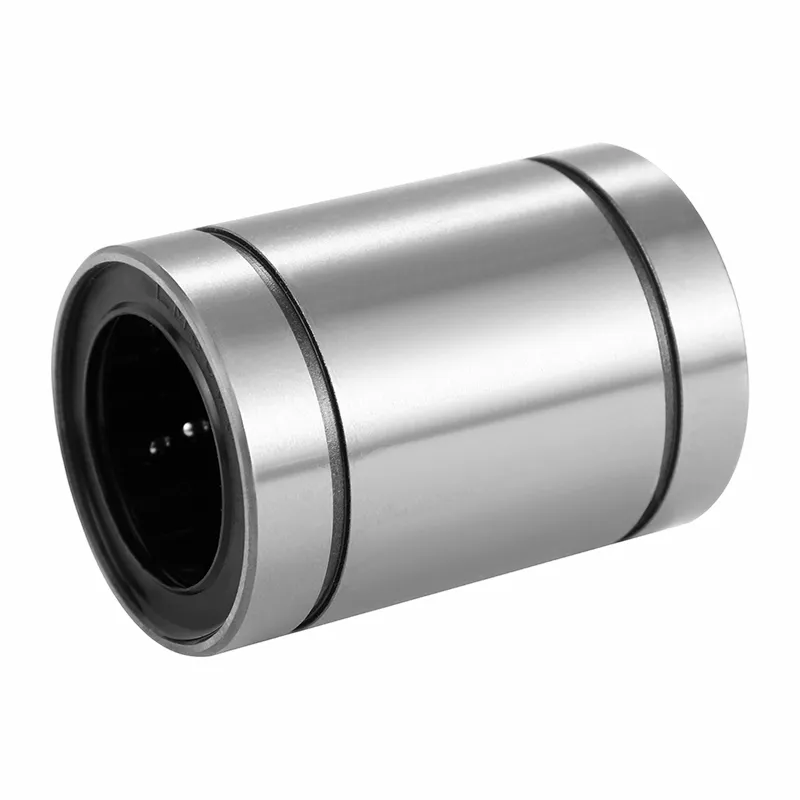
SQ LM20UUAJ
A Quick Reference for Common Applications
| Application | Shaft Fit (Inner Ring) | Housing Fit (Outer Ring) |
|---|---|---|
| Electric motors, pumps | k5, m5 | H7 |
| Conveyors, general machinery | js5, k5 | H7, JS7 |
| Heavy shock loads | n6, p6 | H7 |
| Outer ring rotating (wheels, pulleys) | h6, g6 | N7, M7 |
| Frequent disassembly needed | h6 | H8 |
The Failure Modes to Keep in Mind
Too loose on the rotating ring and you get creep. The ring slowly rotates against its seating surface, generating heat and metallic debris that works its way into the raceway. The housing bore or shaft journal ends up worn oval, and the bearing fails long before its calculated life.
Too tight across the board and the internal clearance disappears. The bearing runs hot, fatigue life drops, and in severe cases the rolling elements seize against the raceway.
Neither failure announces itself loudly at first. By the time vibration or temperature alarms trigger, the damage is usually already done. Getting the fit right at the design stage costs almost nothing. Fixing it later, after a housing has been worn out, costs considerably more.